
People with memory concerns will now be offered a simple blood test for Alzheimer’s disease through their GP, as part of a landmark new study.
Led by Scottish Brain Sciences, the project will explore how blood tests could speed up diagnosis, help GPs decide on the best care for patients, and give people earlier access to support and treatments.
Over 50 [MT1] GPs in Central and Northern Scotland will take part in the BriDGe Study (Bringing Alzheimer’s Disease Biomarkers to General Practice), with the aim to have up to [MT2] 500 patients referred to receive a test, making it the largest UK study of Alzheimer’s blood tests in general practice.
The study aims to build GP experience and confidence in using these new tests, and to assess their value at the earliest stages of disease progression – where quicker, more accurate information could make the greatest difference for patients and their families.
The project is supported by Roche Diagnostics, who developed the blood tests being used in the research.
About the study
The BriDGe study will test two of the most advanced blood markers for Alzheimer’s disease – known as p-tau181 and p-tau217.
When found in the blood, these proteins reflect changes in the brain associated with Alzheimer’s disease. International research shows they may detect or rule out the condition earlier and more accurately than many existing memory tests or scans.
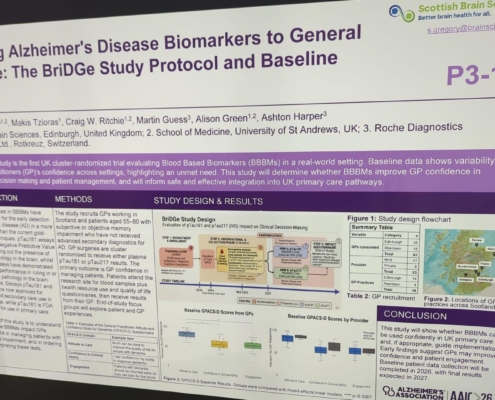
Participating GPs will identify patients for whom additional information could support a diagnosis. Patients will attend a Scottish Brain Sciences research centre in Edinburgh or Aberdeen for a simple blood test. Results will be shared with their GP, and researchers will follow how this influences their diagnostic assessment and decisions about the care that patients then receive.
By embedding blood testing into GP surgeries, the BriDGe Study will explore how cutting-edge science can be translated into everyday healthcare – providing faster answers for patients and families, reducing pressure on specialist memory services, and offering a gateway to clinical trials and emerging new treatments.
The study builds on pilot work led by Alzheimer Scotland, in which Alzheimer’s blood tests were trialed in a small group of patients. BriDGe represents the next critical step: scaling up GP and patient involvement, embedding the tests within primary care, and establishing the infrastructure needed for wider healthcare adoption.
Professor Craig Ritchie, Chief Investigator of the BriDGe project and CEO and Founder at Scottish Brain Sciences, said:
“Blood tests for Alzheimer’s are one of the most exciting developments in dementia research in a generation. We now need to understand how they work in real-world healthcare. By partnering with 50 GPs and up to 500 patients, BriDGe will show how these tests could transform the way we detect, diagnose and ultimately treat Alzheimer’s disease.”[SG3]
Dr Sheelagh Harwell, Senior Associate GP at GP-Plus in Edinburgh, is one of the GPs participating in the study. She said:
“The BriDGe study heralds an exciting time in General Practice as new diagnostic blood tests become available. Consultations are shifting from physicians discussing dementia risk with patients, to discussing brain health. An earlier diagnosis of Alzheimer’s can aid patients with lifestyle modifications, allow them to access support sooner, and plan ahead.”
Martin is a participant in a different study at Scottish Brain Sciences. Since noticing significant changes to his thinking and memory, he has been seeking answers but says the diagnostic process has been confusing.
“I have had conflicting information from healthcare professionals which has left me in limbo. I had tests through my GP and was told it is likely I have Alzheimer’s Disease so I was referred to a psychiatrist at my local hospital. The psychiatrist told me I didn’t have Alzheimer’s, without carrying out any tests. I was quite shocked. The information available online is confusing too.
“I joined research to get some answers and better understand what is going on. If a blood test was available through my GP that could make the diagnosis process easier – and potentially quicker – I would be very willing to take it.”
Ashton Harper, Global Medical Affairs Lead for Neurosciences at Roche Diagnostics, said:
“We’re very proud to be supporting the BriDGe study, which will generate much-needed evidence for the use of new innovative diagnostic tests for Alzheimer’s disease. We hope that the availability of simple blood tests like p-tau181 and p-tau217 through primary care will allow patients and their families to receive answers more quickly when it matters most.
“This landmark collaboration between GPs, research teams, and patients in Scotland could help change the trajectory of Alzheimer’s diagnosis for patients, paving the way for earlier detection and better access to treatment and care.”
GPs can register interest to take part in the study by contacting Scottish Brain Sciences [MT4] at referrals@brainsciences.scot. [5] [AB6]
More News
 https://brainsciences.scot/wp-content/uploads/2023/05/brain-LAPTOP-5IMM1KGQ.jpg
400
640
Denise Fraser
https://brainsciences.scot/wp-content/uploads/2025/11/SBS-web-logo5-1.png
Denise Fraser2023-05-16 11:53:122025-12-15 12:56:04Edinburgh team show how Alzheimer’s spreads
https://brainsciences.scot/wp-content/uploads/2023/05/brain-LAPTOP-5IMM1KGQ.jpg
400
640
Denise Fraser
https://brainsciences.scot/wp-content/uploads/2025/11/SBS-web-logo5-1.png
Denise Fraser2023-05-16 11:53:122025-12-15 12:56:04Edinburgh team show how Alzheimer’s spreads © VadimGuzhva Adobe Stock
https://brainsciences.scot/wp-content/uploads/2023/05/©-VadimGuzhva-Adobe-Stock.jpg
400
640
Denise Fraser
https://brainsciences.scot/wp-content/uploads/2025/11/SBS-web-logo5-1.png
Denise Fraser2023-05-11 11:01:512023-05-24 11:59:18The silent victims of brain injury
© VadimGuzhva Adobe Stock
https://brainsciences.scot/wp-content/uploads/2023/05/©-VadimGuzhva-Adobe-Stock.jpg
400
640
Denise Fraser
https://brainsciences.scot/wp-content/uploads/2025/11/SBS-web-logo5-1.png
Denise Fraser2023-05-11 11:01:512023-05-24 11:59:18The silent victims of brain injury https://brainsciences.scot/wp-content/uploads/2023/04/SBS-Featured-Image.jpg
554
396
Digital Essence
https://brainsciences.scot/wp-content/uploads/2025/11/SBS-web-logo5-1.png
Digital Essence2023-04-24 15:30:252023-04-26 10:43:58Pharma companies collaborate on early Alzheimer’s diagnoses
https://brainsciences.scot/wp-content/uploads/2023/04/SBS-Featured-Image.jpg
554
396
Digital Essence
https://brainsciences.scot/wp-content/uploads/2025/11/SBS-web-logo5-1.png
Digital Essence2023-04-24 15:30:252023-04-26 10:43:58Pharma companies collaborate on early Alzheimer’s diagnoses