The PrevenTRON study is investigating whether a treatment could help delay or prevent the symptoms of Alzheimer’s disease.

We’re proud to announce that Scottish Brain Sciences is the only organisation in Scotland to open recruitment to PrevenTRON, a global Phase III clinical study investigating whether intervening before symptoms emerge could help delay or prevent Alzheimer’s disease dementia.
The study is focused on people who are cognitively healthy — meaning they are not experiencing problems with their memory or thinking — but who may be at increased risk of developing Alzheimer’s disease in the future.
By targeting Alzheimer’s disease at its earliest biological stages, before symptoms develop, PrevenTRON aims to help researchers understand whether earlier intervention could change the course of the disease.
For us, opening recruitment in Scotland is an important milestone. It reflects the growing role Scotland can play in international Alzheimer’s research and our commitment to bringing opportunities to take part in innovative research to people across the country.
Bringing prevention research to Scotland
We’re delivering PrevenTRON in partnership with the study sponsor Roche and imaging support from the University of Aberdeen.
Recruitment is now underway at our research centre at the BioHub in Aberdeen, and we expect to open recruitment shortly at our centre at Scottish Gas Murrayfield Stadium in Edinburgh.

BioHub, Aberdeen
Our established participant recruitment infrastructure, including our IONA cohort study, is supporting the study. More than 850 people have already joined IONA, helping us connect people interested in brain health research with opportunities to take part in studies.
This infrastructure allows us to build relationships with participants over time and, where appropriate, connect research-ready volunteers with new research opportunities.
Professor Craig Ritchie, our Chief Executive Officer and Founder, said:
“Opening recruitment as the first Scottish site for PrevenTRON demonstrates the strength of the model we have built at Scottish Brain Sciences. We’ve invested in the infrastructure, partnerships and participant platforms needed to support complex prevention studies, and that investment is now translating into rapid study activation and recruitment capability.
“Through our IONA cohort, we’re able to connect research-ready participants with internationally significant studies more efficiently, helping accelerate research while expanding opportunities for people in Scotland to contribute to shaping the future of Alzheimer’s prevention.”
Could you take part?
We’re looking for cognitively healthy adults who are not experiencing memory or thinking problems but who may be at increased risk of developing Alzheimer’s disease.
A family history of Alzheimer’s disease is one of the factors our research team may consider when assessing whether someone could be suitable for further screening.
Taking part involves a number of assessments to determine whether someone meets the specific eligibility criteria for the study.
It’s important to remember that PrevenTRON is an investigational clinical study. We do not yet know whether the study treatment will delay or prevent symptoms of Alzheimer’s disease.
“Taking part in research is something we can actively do”
For our research participant Rob Mitchell, the opportunity to contribute to Alzheimer’s research has a personal significance.
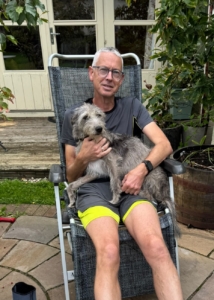
Rob’s father was diagnosed with Alzheimer’s disease, so he has seen first-hand the impact the condition can have on individuals and their families.
He said:
“Having seen first-hand what Alzheimer’s can do to someone you love, the idea that research could one day delay or prevent those symptoms is hugely significant. It could be utterly transformational.
“When my dad was diagnosed with Alzheimer’s, I felt a huge sense of helplessness. Taking part in research is something we can actively do, something positive and something to be proud of.”
We believe research has the potential to change the future of brain health. Opening PrevenTRON in Scotland gives more people the opportunity to contribute to that research and help us understand whether intervening earlier could make a difference to the lives of people at risk of Alzheimer’s disease.
More news from Scottish Brain Sciences
 Scottish Brain Sciences
https://brainsciences.scot/wp-content/uploads/2023/05/Craig-640x400-1.jpg
400
640
Denise Fraser
https://brainsciences.scot/wp-content/uploads/2025/11/SBS-web-logo5-1.png
Denise Fraser2023-05-22 13:33:452023-05-22 13:33:49The hope for a life-long healthy brain
Scottish Brain Sciences
https://brainsciences.scot/wp-content/uploads/2023/05/Craig-640x400-1.jpg
400
640
Denise Fraser
https://brainsciences.scot/wp-content/uploads/2025/11/SBS-web-logo5-1.png
Denise Fraser2023-05-22 13:33:452023-05-22 13:33:49The hope for a life-long healthy brain https://brainsciences.scot/wp-content/uploads/2023/05/brain-LAPTOP-5IMM1KGQ.jpg
400
640
Denise Fraser
https://brainsciences.scot/wp-content/uploads/2025/11/SBS-web-logo5-1.png
Denise Fraser2023-05-16 11:53:122025-12-15 12:56:04Edinburgh team show how Alzheimer’s spreads
https://brainsciences.scot/wp-content/uploads/2023/05/brain-LAPTOP-5IMM1KGQ.jpg
400
640
Denise Fraser
https://brainsciences.scot/wp-content/uploads/2025/11/SBS-web-logo5-1.png
Denise Fraser2023-05-16 11:53:122025-12-15 12:56:04Edinburgh team show how Alzheimer’s spreads © VadimGuzhva Adobe Stock
https://brainsciences.scot/wp-content/uploads/2023/05/©-VadimGuzhva-Adobe-Stock.jpg
400
640
Denise Fraser
https://brainsciences.scot/wp-content/uploads/2025/11/SBS-web-logo5-1.png
Denise Fraser2023-05-11 11:01:512023-05-24 11:59:18The silent victims of brain injury
© VadimGuzhva Adobe Stock
https://brainsciences.scot/wp-content/uploads/2023/05/©-VadimGuzhva-Adobe-Stock.jpg
400
640
Denise Fraser
https://brainsciences.scot/wp-content/uploads/2025/11/SBS-web-logo5-1.png
Denise Fraser2023-05-11 11:01:512023-05-24 11:59:18The silent victims of brain injury