The founder and CEO of Scottish Brain Sciences, Professor Craig Ritchie, is predicting that science, medicine and research will come together to reduce the impact of conditions such as Alzheimer’s disease.
Professor Ritchie was speaking as part of a Scotland Tonight documentary to be screened this evening (23 November), which tells the story of a family managing the impact of early-onset dementia.
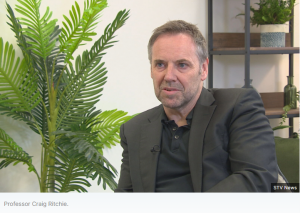
“There’s a huge amount of really incredible research going on around the world and the reason for setting up Scottish Brain Sciences was to try and accelerate the delivery of that research into treatments and tests for people in Scotland and across the world.”
A series of partnerships with global diagnostics, pharmaceutical and research teams will allow the Edinburgh-based company to assess people and match them with appropriate clinical trials of new diagnostics and treatments.
There is mounting evidence that up to 40% of people will be able to reduce their risk of dementia through taking steps such as stopping smoking, reducing their blood pressure or getting involved in activities that help them be less socially isolated.
Scotland is the first country to have set up a government-sponsored health programme, Brain Health Scotland, led by Alzheimer Scotland, to help people understand how to reduce their risks of disease in later life.
The key for everyone, Professor Ritchie says, will be to identify the earliest signs of brain disease, years and perhaps decades before people become very unwell, and to develop interventions that can slow disease progression:
“Think about where we are with cancer. Everything now is geared towards picking up stage one cancer. If you get it early, the prognosis, the chance of cure, is high.
“So, using that analogy, if we can detect Alzheimer’s disease really early, when proteins in the brain are just beginning to present, I think there’s every opportunity that we can cure Alzheimer’s disease.
“Unfortunately, once you have the dementia stage of illness again, a bit like cancer, it spreads. Other parts of the brain are affected. Other disease processes are taking place.
“I think it’s unreasonable to expect to be able to cure that because the brain is now very diseased. So the hope and the aspiration, and the focus and the energy, have to go into early detection.”
Professor Ritchie says he has a vision that, at the very least, brain illnesses will become something people can live well with rather than die from:
“HIV and AIDS is a very good example of this. We might have lots of people living with HIV but, here in the UK at least, nobody gets AIDS anymore.
“We’ll have lots of people with Alzheimer’s disease – but at the early stages. It would be a failure on the part of medicine if those people then progressed to developing dementia.”
If you are interested in finding out more about clinical research into brain conditions, go to Join Dementia Research.
Latest news and research
 https://brainsciences.scot/wp-content/uploads/2025/11/20251114_SBS_BIOHUB_005.jpg
1600
2400
Denise Fraser
https://brainsciences.scot/wp-content/uploads/2025/11/SBS-web-logo5-1.png
Denise Fraser2026-09-17 18:30:002026-09-17 18:53:58Recruitment in Scotland opens for landmark Alzheimer’s prevention study
https://brainsciences.scot/wp-content/uploads/2025/11/20251114_SBS_BIOHUB_005.jpg
1600
2400
Denise Fraser
https://brainsciences.scot/wp-content/uploads/2025/11/SBS-web-logo5-1.png
Denise Fraser2026-09-17 18:30:002026-09-17 18:53:58Recruitment in Scotland opens for landmark Alzheimer’s prevention study https://brainsciences.scot/wp-content/uploads/2026/08/IMG-20260530-WA0010.jpg
1600
1200
Denise Fraser
https://brainsciences.scot/wp-content/uploads/2025/11/SBS-web-logo5-1.png
Denise Fraser2026-08-30 23:00:002026-08-28 09:22:20Why Rob Says Yes to Alzheimer’s Research
https://brainsciences.scot/wp-content/uploads/2026/08/IMG-20260530-WA0010.jpg
1600
1200
Denise Fraser
https://brainsciences.scot/wp-content/uploads/2025/11/SBS-web-logo5-1.png
Denise Fraser2026-08-30 23:00:002026-08-28 09:22:20Why Rob Says Yes to Alzheimer’s Research https://brainsciences.scot/wp-content/uploads/2026/08/the-scottish-national.jpg
667
1000
Denise Fraser
https://brainsciences.scot/wp-content/uploads/2025/11/SBS-web-logo5-1.png
Denise Fraser2026-08-12 10:18:062026-08-12 10:18:08Free Edinburgh event invites public to discover more about Alzheimer’s research
https://brainsciences.scot/wp-content/uploads/2026/08/the-scottish-national.jpg
667
1000
Denise Fraser
https://brainsciences.scot/wp-content/uploads/2025/11/SBS-web-logo5-1.png
Denise Fraser2026-08-12 10:18:062026-08-12 10:18:08Free Edinburgh event invites public to discover more about Alzheimer’s research